Singapore

20 October 2013

More Than 50 Shades of Grey

The topic in our camera club at the last meeting was Black and White photography, something I've been interested in for many years. In my younger days I had a darkroom where I developed films and prints. Of course nowadays it's much easier to do with digital camera settings and computer software. My daughters gave me NIK software last Christmas to do HDR pictures. Imagine the surprise Google gave me recently (Google bought out NIK), when they presented me with complementary upgrades to the entire range, including this little gem:

Silver Efex Pro 2
This is the program you use to manipulate monochrome images. It's amazing what you can do with it. I went through my Archives and converted some of my photos.

Rainforest walk at Paronella Park, Innisfail

Waterfall at Paronella Park, Innisfail

The old Barn

Brig O'Doon, Ayr, Scotland

Scene from the Sunlander

Dog, Hunter Valley

12 October 2013

Brisbane Open House


It's the weekend of the year when a lot of public buildings are open to the public. It only happens once a year and we investigated which buildings we wanted to visit. Top of the list was the old Boggo Road Jail, infamous for holding people like the Postcard bandit and the Whiskey-A-Gogo arsonists. Alas, the place is now closed and became a museum. It was worth a visit.

Unfortunately when we got there, we discovered we were not the only visitors and there were very long queus only just to put your name down for  a tour later on during the day. We discovered that the tours are on all through the year, so we'll do it some other time.

It was coffee time and right next door is a new complex housing the Ecosciences precinct, which also has a coffee shop. So we decided to visit that building instead (for two reasons).


The old Boggo Road Jail from top of the Ecoscience Building

Boggo Road precinct from Google Map (left is the old jail)

The Ecoscience complex

Inside the foyer

View from the roof, just as an Ipswich train passes Yeerongpilly

Modern sitting room

Looking down into the foyer from Level 5

One of the labs that was open
And another

The building was designed by 'Hassle Architects', the company, our daughter works for. As it happened, the Hassle Studio was open to the public as well, so that's where we headed next.

09 October 2013

Riccotta and Spinach Ravioli

I'm an avid fan of a UK show on cable called 'Come Dine With Me.' The show is recorded in several countries, UK, Ireland, Australia and South Africa. A group of people are hosting dinner parties at each other's residences, then score each other on the food and the dinner party in general. There are plenty of human failings on show but also interesting dinner menus. On one of those dinners, in South Africa, the lady prepared spinach and ricotta ravioli. I thought, how difficult can that be? Admittedly, she had a machine to roll the pasta dough, which I have not, so out came the old rolling pin, which itself is an heirloom from Diane's mum and must be a hundred years old. But it still works.

So, I mixed plain flour, an egg and salt and started kneading, folding and rolling by hand until I had the dough pretty thin. Unfortunately the blogger wasn't at hand to take photos of that procedure, but you get the picture.

With a glass the right shape, I stamped the dough into circles


From our own garden, I cut some spinach and after steaming it I diced it and mixed it with ricotta cheese to make the filling.


It's a bit of a fiddly job to get the amount right so the ravioli don't split for being over full.


Then I wet the edge with a little milk, folded the ravioli in half and sealed the edges with a fork.


Into salted boiling water for about 8 minutes, stirring occasionally.


To serve, I made a tomato sauce using a tin of diced basil and garlic tomato and a tub of tomato puree together with herbed spices and the trusty Maggi seasoning which I use in just about everything (except maybe ice cream).

The end result, a beautiful pasta meal for the blogger and me. Bon Appetito..


26 September 2013

Brisbane River Festival 2013

We went to see the laser show at the Brisbane River Festival 2013 the other night. The laser show is repeated several times every night and is spectacular.

Brisbane City from South Bank as part of my present masthead

The laser show is very colourful

The "screen' is set up on a pontoon on the river

A light show is also installed in front of the Performing Arts Complex

Here is a short video of the Laser Show


22 September 2013

Art In Aviation

Our Camera Club was invited to participate in the Art In Aviation Event organised by the Gold Coast Sports Flying Association and held at Heck Field Airstrip at Jacobs Well, south of Brisbane.

 The planes arrived at around 9 o'clock and members were ready for them.

Don't ask me makes and models of these planes, I wouldn't know.


One of the reporters from the Sports Pilot Magazine approached me with a request. He is writing an article about the following aircraft. He had his 11 year old son with him. His request, 'Can you please take a shot of this plane with my son in it and make it look like they are flying? But he must not look 11 years old. We would like to use it on the cover of the next magazine issue with my article.'

The Blogger had the same idea

No problem at all.


In October, they are holding an Open Day, where we can all display our photos and hopefully win a prize. That'll cut me out, but we have some excellent snappers in our midst, so hopefully one of them will take first prize.

28 August 2013

Village Life

This is part 3 of my old Papua New Guinea slides I converted recently.

If you haven't read the previous couple of posts, I used to live and work in Papua New Guinea between 1967 and 1970. I was frequently flying between towns and consequently saw a lot of this fascinating country.

While staying in Madang, the owner of the motel drove us into the hills where we visited this native village.

 The houses are built off the ground to stop animals from entering and to provide some cooling. It is very hot on PNG, all year around, 24 hours a day so any type of cooling is welcome.


A typical Madang house

As soon as we arrived, the picanninis (children), came to check us out. The villagers were very friendly and always welcomed visitors. 

The Village Square with the local kids

The men were out hunting gathering and left the womenfolk to look after the villages. The women were pottering, producing ware they would take to the local markets to sell,

This woman is finishing a pot

Of course, they also looked after the children and small farming animals such as pigs and chickens.

Mum with her two children
In Manus Island, we worked in the Australian navy base, 'HMAS Tarangau'. We were building the communications building. I employed a young boy by the name of Pius, to help me with the electrical installation. He had just left school and was looking for work. He was a good worker and willing to learn. He showed me how to get coconuts straight out of a tree, by climbing up without ropes or ladders.

Pius is picking a coconut
In Wewak, in the Sepik District, we played soccer on the beach on a Sunday and before long, the local kids joined us in the fun. The kid standing in front of me is wearing my sunnies.

On a beach with the local children

Also on a beach in Wewak, I took a picture of this woman carrying her shopping home in typical New Guinea fashion with a net carried with her head.

A woman carrying her goods.
It is such a shame that the people in Papua New Guinea can't get their act together. It could be a fantastic tourist destination for people around the world. Instead, the country is dominated by corruption and fighting and today is one of the most dangerous places to live. I am so happy, it was paradise in the 60s when we lived there.


21 August 2013

Plane Wrecks in Papua New Guinea

This is part 2 of my slides from my time in Papua New Guinea in the 60s. I was travelling a lot throughout the territory as it was then known and came across a lot of plane wrecks from WWII, when the Japanese occupied the territory. But I also had some dangerous flying experiences while getting around.

Japanese plane crashed just outside Port Moresby

Another Japanese wreck near Wewak

This one came down on Manus Island

I tried to start it up but no success
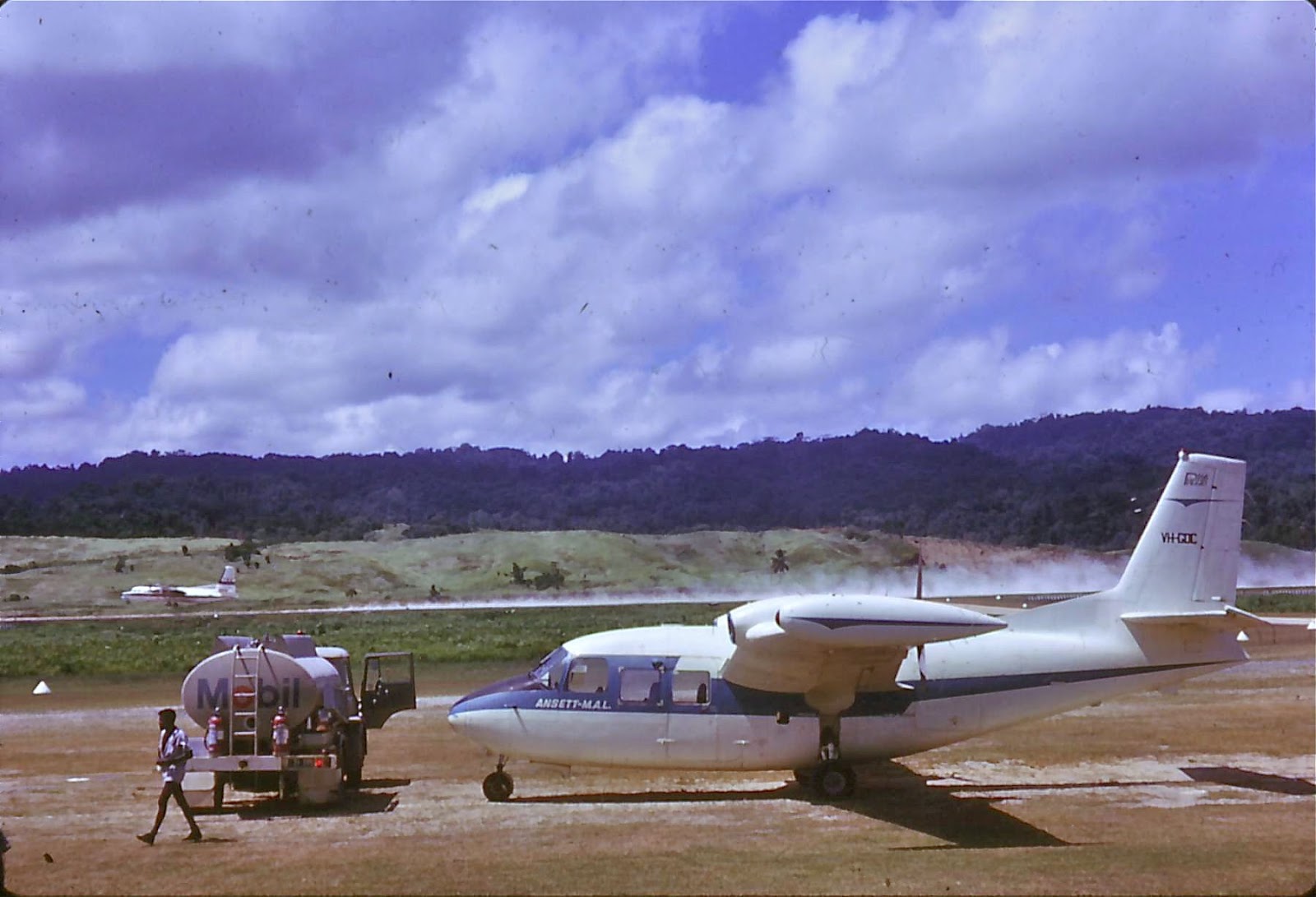
On one of my trips to the border town of Vanimo, we returned back to Wewak in the Piaggio (Below). About half way into a 2 hour flight, we came across a solid black wall of a storm ahead of us. I was sitting next to the pilot. He radioed Wewak and told them of the storm. They instructed him to try to fly around it. We banked left and had the wall to our right while we were cruising along it. It really looked like a solid wall.

After about 30 minutes, the pilot reported that there was no way we could fly around this wall and we didn't have enough fuel to return to Vanimo. After some debate between the control tower in Wewak and the pilot. it was decided to do an emergency landing at Aitape, a copra plantation on the way. The tower alerted the station owners. By now it was getting dark. The owners send some Toyota 4X4s to come and light up the air strip so we could land.

We made it and the pilot taxied the plane to higher ground as the rain can flood the air strip, sometimes for days. We were transported to the plantation just as the storm hit. We were fed and spent the night there and in the morning, were able to resume our trip back to Wewak.

Piaggio at Vanimo ready to fly us back to Wewak
Next Time: Village Life.